
No Harding County 72 Hour Releases
Harding County does not publish a 72-hour release list. It cannot produce a jail feed because it operates no jail. The New Mexico Counties directory states that Harding lacks a detention center, and the statewide facility review found no adult detention facility or prison there. The sheriff remains the key local starting point because its transport record can identify the outside holder.
The documented Lea County detention agreement creates a space-available route, not a dedicated Harding release stream. Lea County also publishes no verified 72-hour view. A three-day Harding inquiry must be built from dated agency records: the sheriff’s transfer information, the holding jail’s admission and final movement entries, and the court’s order or disposition. That method is slower than opening a feed, but it resolves the more important question of whether custody actually ended.
Build Harding County Three-Day Releases
Treat the 72-hour period as a request window. Set the start and end dates first, then identify every office that holds one part of the event. The Harding County Sheriff’s Office can identify where a person was taken. The receiving jail can provide the physical movement. The New Mexico court file can supply the legal order. This is especially useful when one part of the record is dated late in the period.
- Define the exact three-day interval, including the local date and the cutoff time needed for the inquiry.
- Ask Harding County Sheriff which facility accepted the person and request the arrest and transport dates it holds.
- Contact that facility with the full booked name, approximate dates, incident or case number, and booking identifier if known.
- Request all final movement entries within the interval, including release time, authority, disposition, and destination.
- Use New Mexico Courts Case Lookup to match the release or bond order, dismissal, sentence, or probation entry.
- If the movement says transfer, check the receiving jail, NMCD, BOP, or immigration custodian rather than counting it as community release.
A same-day question may be easier to check through the Jail Releases: 24 Hours workflow. The three-day method is designed for a batch of dated events, not just one current roster check.
Harding County Weekend Release Records
A three-day range is useful when court action and jail processing cross calendar days. A bond order might appear before the outside jail completes identification, property return, and the final movement entry. Records staff may also complete or correct a field after the person has left. No Harding-specific weekend practice, holiday schedule, release time, or guaranteed posting delay was found, so none should be assumed.
Use timestamps instead of labels such as “weekend release.” Record the court order date and time, the jail exit date and time, and the date each public system was viewed. If a holiday closes an office, send a focused written request and preserve the submission time. The eventual response can still identify whether an event fell within the chosen 72-hour period.
| Time point | Likely custodian | Why it matters |
|---|---|---|
| Arrest or transport | Harding County Sheriff | Identifies the start and the receiving facility. |
| Release order | Harding court | Shows the legal authority and when it was entered. |
| Physical exit | Actual holding jail | Shows when that custodian ended control. |
| Transfer admission | Receiving agency | Shows whether confinement continued after the first booking closed. |
Note: No official source promises that a Harding-related release will appear online by the next day or remain visible for three days.
Harding County 72 Hour Record Fields
No public Harding or Lea three-day table supplies release fields. Build the event set from records returned by the actual holder. Each row should describe one custody episode, not merely one person. A person may have more than one movement during the same interval, and a transfer can create a closing entry at one agency plus an admission at another.
| Requested field | Use in a three-day review |
|---|---|
| Full booked name and aliases | Matches records that may use different name forms. |
| Booking and incident numbers | Separates distinct custody episodes. |
| Admission date and time | Places the episode within or before the review window. |
| Release date and time | Tests whether the physical exit occurred in the interval. |
| Authority or release reason | Connects the exit to bond, dismissal, sentence completion, probation, parole, or another basis. |
| Destination and movement history | Shows community release or continued custody with a new authority. |
The release authority may be a court order, sentence event, or other approved basis. A release record answers what the jail did. A court file explains why it could do so. Neither should be stretched beyond its role. A court order may not show the exact exit minute, while a jail timestamp may not contain the full legal disposition.
Lea Roster Has No Archive
The official Lea County Detention Center roster matters only when Lea was the confirmed holder. Its dated “Automated System” page is not a rolling release log. It shows Inmate ID, Last Name, and First Name. It has no release date, booking date, originating agency, disposition, destination, photograph, detail page, or archive.
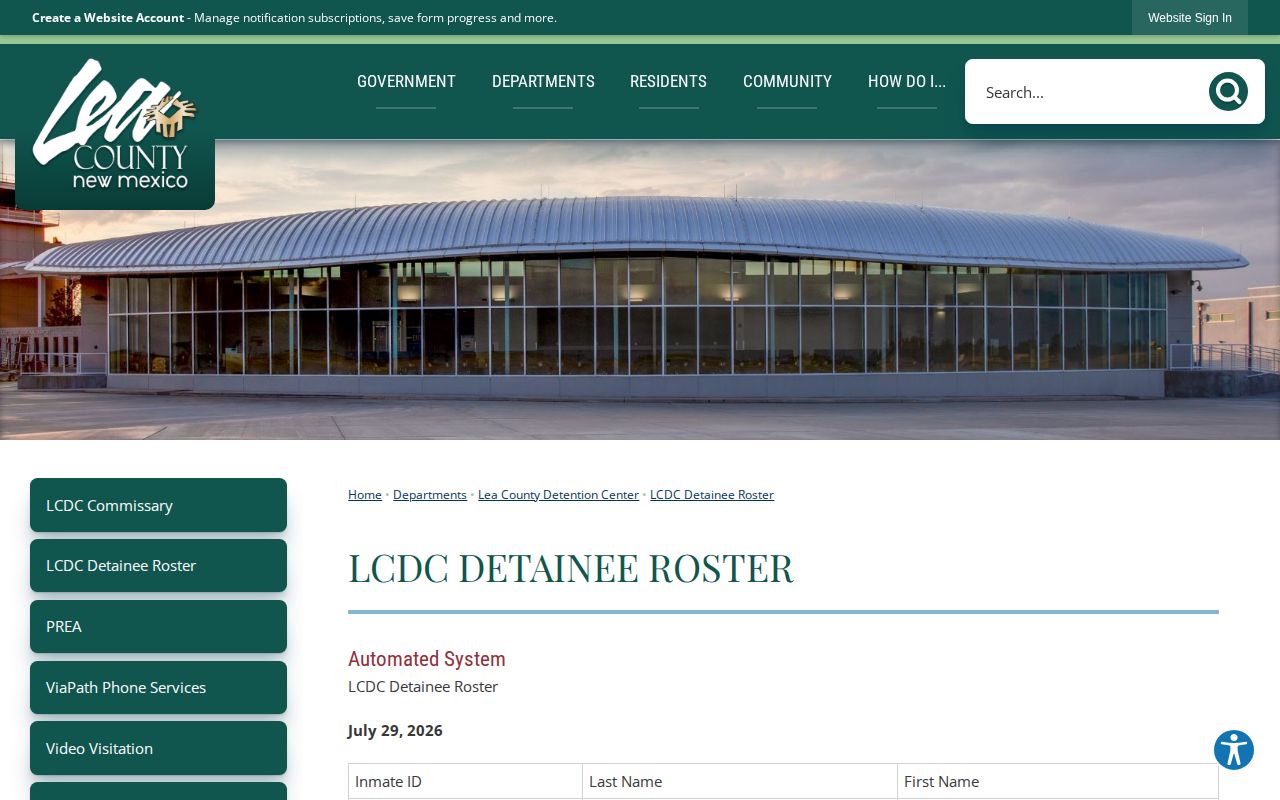
The captured official page documents the three columns and the lack of a past-release window. It can help obtain an identifier while a person is listed. It cannot recreate which names left during the prior three days after entries disappear.
No official source found in the Harding research gives a fixed refresh cadence, removal rule, or retention time for the roster. The date on the page marks the displayed view, not a promise about historical access. Downloading or comparing current names would still fail to reveal whether any disappearance meant community release, transfer, a corrected identity, or another update.
Request Harding County Release Records
A narrow request can ask the custodian for release events whose physical exit times fell within a stated interval. Include the exact beginning and end of the 72-hour period. If the request is about one person, provide the full name, date of birth if known, approximate arrest date, Harding incident number, court case number, and the receiving facility. If it is about several known episodes, identify each one rather than requesting an undefined database export.
Harding County Sheriff holds its own arrest and transport material. The actual jail holds booking, release, movement, property, and booking-photo records created in its system. For a confirmed Lea placement, send the focused request through the Lea County Public Information Officer route. Ask for electronic records, segregable disclosure with lawful redactions, and the legal basis for any withheld part.
Lea County Detention Center1401 South Commercial Street
Lovington, NM 88260
Administration: 575-396-8669
Adult Records fax: 575-396-8506
Records email: recordsrequest@leacounty.net
Do not request a generic “Harding jail list” from Lea unless Lea first confirms it can identify the relevant records that way. The detention agreement is space-available, and the roster does not show originating agency. A person associated with Harding may have been held by a different outside agency.
Sort Harding County Release Endpoints
The final destination controls whether an event belongs on a community-release list. Bond, recognizance, dismissal, time served, or sentence completion may produce community release. Probation can place the person in the community under a court sentence. Parole follows a state prison term and remains a form of correctional supervision. A transfer to NMCD, another jail, USMS, or immigration custody is not community release.
- Community release
- The person leaves confinement, though court terms or supervision may still apply.
- Transfer
- One agency closes its custody episode because another agency takes the person.
- Parole
- Supervised community status after a state prison term.
- Probation
- Court-ordered community supervision that may follow a conviction without a prison release.
- Discharge
- An end point whose scope must be read from the record, since it may concern custody, parole, probation, or the full sentence.
NMCD’s offender search is for people incarcerated by the department or on NMCD probation or parole. NMCD says it has no jurisdiction over county or city detention. Use that search only after a state commitment or for state supervision. A federal locator likewise proves only the status held by its own custodian.
New Mexico VINE can provide custody-change alerts when the participating agency supplies the selected person’s record. Coverage must be checked at the actual holding-facility level for a Harding County event. An alert is not a legal release certificate, and a move to another jail may require a new search and registration on the receiving record.
Note: Count a record as community release only when the exit code, destination, or matching order supports that result.
Match Harding County Release Orders
The court record remains available after a short jail roster entry disappears. Roy Magistrate Court handles misdemeanors, impaired-driving cases, traffic matters, and preliminary felony proceedings. Harding District Court is part of the Tenth Judicial District. Case Lookup may show bond or release orders, dismissal, plea, judgment and sentence, probation, later completion, or discharge.
Compare each court event with the jail’s physical exit. A person may receive an order on one day and leave the jail on another. The broader 72-hour frame makes that mismatch easier to see, but it does not prove causation by date alone. Use the case number, booking identifier, and release authority to make the match. When the data conflicts, ask both custodians and state the date on which each record was viewed.
For one named person whose route may include NMCD, VINE, or a federal custodian, follow the complete Harding County released-inmate lookup. That broader path is more suitable than treating a reconstructed three-day event set as a person locator.